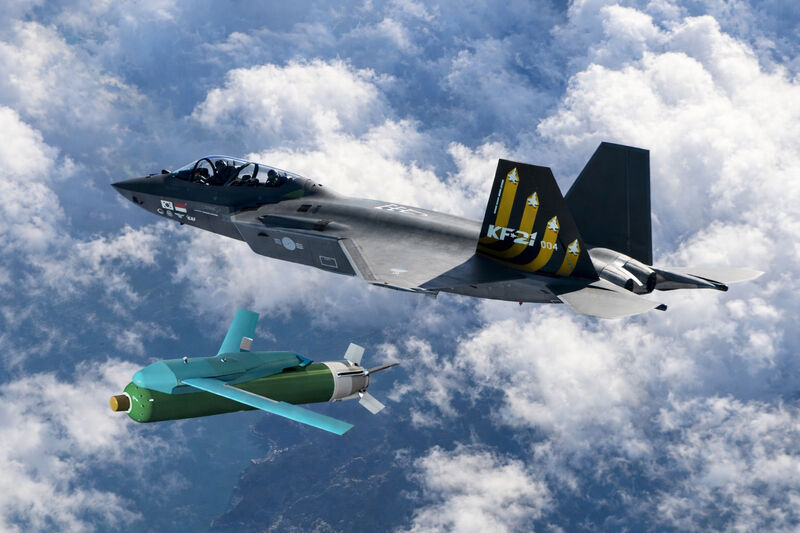
 The blackout bomb’s cluster-type body is believed to be comparable to the U.S. Air Force’s CBU-94/B, but fitted with domestically developed guidance wings and control systems.The weapon—officially referred to as a carbon-fiber bomb or electrical power disruption munition—is regarded alongside electromagnetic pulse (EMP) weapons as a key element in strengthening South Korea’s Three-Axis Defense System, aimed at countering North Korea’s advancing nuclear and missile threats.
Often called a Blackout Bomb, the munition disables electricity by releasing conductive carbon-fiber wires over transmission facilities, causing short circuits and widespread power failures. The concept was first used in combat by U.S. forces during the 1991 Gulf War, when it was dropped on electrical substations in Baghdad.
Development of the Korean blackout bomb is understood to have begun in 2012 under the leadership of Agency for Defense Development. According to sources, Poongsan is responsible for the weapon casing, LIG Nex1 for guidance kits and systems integration, and Hanwha Aerospace for fuse development.
Although the program was initially scheduled for completion by 2024, ADD recently produced prototype munitions and completed secret flight tests. The project has now reportedly entered its final refinement stage.
The blackout bomb is expected to be operated primarily by the Republic of Korea Air Force, which is exploring its use as a long-range precision power-grid disruption weapon. Plans reportedly include integrating the munition with a long-range air-to-surface missile propulsion system comparable to the Cheonryong cruise missile, enabling standoff strikes against substations and key electrical infrastructure.
Sources indicate that multiple configurations are under development, including aircraft-dropped bombs, missile-mounted versions, and standalone guided munitions. The program was first officially referenced in South Korea’s 2017–2021 Mid-Term Defense Plan.
Despite lacking explosive warheads, blackout bombs are regarded as highly effective strategic weapons. During NATO’s 1999 air campaign over Yugoslavia, carbon-fiber munitions reportedly disrupted approximately 70 percent of the country’s power supply. Similar attacks during the 2003 Iraq War disabled regional power grids for weeks.
Because the weapon does not directly cause casualties, it is classified as a soft-kill, non-lethal system, often grouped with high-intensity flash devices and acoustic weapons. Nevertheless, it can temporarily neutralize critical military assets such as command centers, radar installations, and power-dependent weapons systems.
The blackout bomb operates by releasing massive quantities of carbon-fiber wires that damage insulation in electrical transmission systems. Once entangled with power infrastructure, the fibers induce overloads and short circuits, rendering electricity distribution impossible until physical removal is completed.
Experts estimate that restoring power to key facilities can take at least seven hours, while full recovery across general infrastructure may require more than 20 hours—a disruption window capable of severely degrading military command, communications, and operational readiness.
In operation, the weapon is guided to a pre-programmed target area, where submunitions are released several kilometers above the objective. As they descend under parachutes, onboard sensors trigger a secondary release hundreds of meters above the target, dispersing nickel-infused carbon fibers.
Each munition reportedly contains 147 coils of wire, with individual strands extending up to 4.5 kilometers, forming web-like conductive networks that overwhelm power lines and substations.
Recent advances have significantly improved the weapon’s effectiveness. By integrating a guidance kit similar to the Korean GPS Guided Bomb (KGGB), the blackout bomb’s range, accuracy, and attack angles have been substantially expanded.
The bomb’s cluster-type body is believed to be comparable to the U.S. Air Force’s CBU-94/B, but fitted with domestically developed guidance wings and control systems.
According to defense officials, South Korea plans to deploy several hundred carbon-fiber blackout bombs with the Air Force no later than 2028, marking a significant expansion of Seoul’s non-kinetic strike capabilities.
If fielded as planned, the weapon would provide South Korea with a powerful option to neutralize enemy infrastructure rapidly—without triggering immediate large-scale civilian casualties—while maintaining escalation control in a crisis on the Korean Peninsula.
K-DEFENSE NEWS | Strategic Analysis Desk
#정전탄 #한국공군 #전력망무력화 #비살상무기 #3축체계 #BlackoutBomb #ROKAirForce #PowerGridWarfare #SoftKill #ThreeAxisSystem


 North Korea Goes Hypersonic—KAMD Needs Northrop Grumman’s IBCS
 K2PL 기술이전 전면 공개…폴란드, 생산·정비까지 손에 쥔다
 에어버스, 스타럭스 항공에 첫 A350-1000 인도
 “20조 원 넘게 썼다”…폴란드, 사상 최대 군비 지출 ‘예산 밖 돈’으로 집행
 KF-21 블록2 위한 무장시험 시작, 말레이시아 공군 차세대 전투기로 주목!
 목록
목록