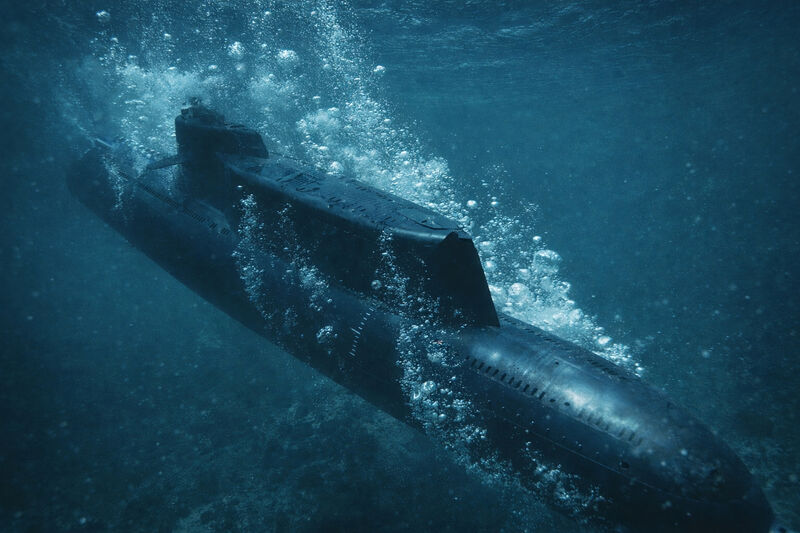
 North Korea’s much-publicized first “tactical nuclear attack submarine,” the Kim Gun-ok Hero, has been found to suffer from serious stability and buoyancy problems and is currently undergoing repairs.The submarine, unveiled by Pyongyang in 2023 as a key pillar of its sea-based nuclear deterrent, is believed to be a heavily modified legacy diesel-electric platform. North Korea claimed the vessel had been adapted to carry up to ten submarine-launched ballistic missiles (SLBMs), a configuration that analysts have long questioned.
According to officials familiar with the assessment cited by TV Chosun, the submarine displayed persistent buoyancy issues during early operations. Air bubbles were reportedly observed escaping continuously from the hull even while submerged, causing the vessel to sink uncontrollably. When surfaced, the submarine was seen listing sharply to one side, indicating serious balance and weight-distribution problems.
“A submarine’s most basic requirement is to maintain buoyancy and horizontal stability,” a South Korean government source told TV Chosun. “Continuous air leakage and repeated sinking suggest fundamental design or structural flaws.”
Defense experts point to structural limitations stemming from the submarine’s redesign. Moon Keun-sik, a professor at Hanyang University, was quoted as saying that North Korea appears to have extended the hull length to add missile tubes while keeping the original beam unchanged—an approach that severely complicates balance and degrades maneuverability.
Operational patterns further raise doubts about combat readiness. Since its launch, the Kim Gun-ok Hero has reportedly spent most of its time moored rather than conducting sea trials. Satellite imagery shows the submarine moved into a dry dock at the Sinpo South Shipyard, where large-scale repair or modification work is believed to be underway.
TV Chosun also reported that the submarine was briefly listed in an international maritime registration system before the entry was removed, possibly at Pyongyang’s request to limit external scrutiny.
The findings cast renewed doubt on North Korea’s claims of possessing a credible sea-based nuclear strike capability. While Pyongyang continues to emphasize submarines as a core element of its nuclear force, analysts say major technical and operational hurdles remain before such a platform can be considered viable.
South Korean and allied intelligence agencies are expected to continue closely monitoring developments at the Sinpo shipyard, widely regarded as the center of North Korea’s submarine and naval nuclear ambitions.
K-DEFENSE NEWS | Strategic Analysis Desk
#NorthKorea #NuclearSubmarine #KimGunOkHero #SLBM #SubmarineFlaws
#DefenseNews #MilitaryIntel #IndoPacific #KoreanPeninsula


 North Korea Goes Hypersonic—KAMD Needs Northrop Grumman’s IBCS
 K2PL 기술이전 전면 공개…폴란드, 생산·정비까지 손에 쥔다
 에어버스, 스타럭스 항공에 첫 A350-1000 인도
 “20조 원 넘게 썼다”…폴란드, 사상 최대 군비 지출 ‘예산 밖 돈’으로 집행
 KF-21 블록2 위한 무장시험 시작, 말레이시아 공군 차세대 전투기로 주목!
 목록
목록