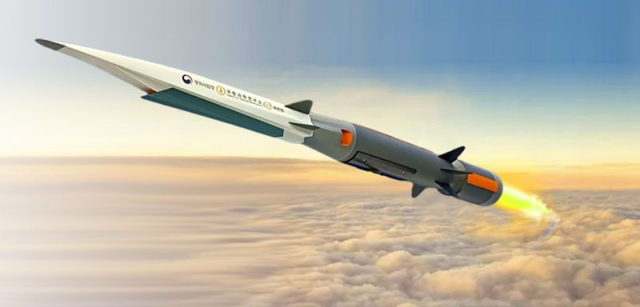
 The South Korean military intends to deploy HyCore across multiple platforms.Hypersonic flight refers to speeds of Mach 5 or higher—more than five times the speed of sound. While conventional aircraft and missiles typically operate below Mach 3, hypersonic weapons combine extreme speed with maneuverability, making interception by existing air and missile defense systems exceedingly difficult. By blending key characteristics of ballistic and cruise missiles, hypersonic cruise missiles occupy a unique operational niche.
According to defense sources, HyCore has already completed successful test flights and technical validation. The system reportedly exceeded its original development target of sustaining Mach 5 flight for more than five seconds, reaching a peak speed of Mach 6. These achievements led to HyCore being shortlisted for the “Top 10 Technologies of Korea 2025,” overseen by the Korean Society of Mechanical Engineers.
HyCore is classified as a “multi-regime flight vehicle,” capable of operating in both supersonic (Mach 3+) and hypersonic (Mach 5+) regimes. This is enabled by a dual-mode propulsion concept. At lower hypersonic speeds, the missile uses a ramjet engine, which transitions to a scramjet (supersonic combustion ramjet) as velocity increases—an approach often referred to as a dual-ramjet or combined-cycle system.
While HyCore’s performance has been verified, analysts note that the program is still at the advanced test-vehicle stage, approaching but not yet reaching full weaponization. South Korea has nevertheless secured core design know-how and propulsion technologies critical to operational deployment. In terms of configuration, HyCore bears similarities to X-51A Waverider, a scramjet-powered hypersonic flight demonstrator developed by Boeing for the U.S. Air Force.
The South Korean military intends to deploy HyCore across multiple platforms. Ground-launched tests using vertical launch systems have already been conducted successfully, and the missile could ultimately evolve into a hypersonic air-to-surface Missile.
Air-launched variants are also under development, with integration planned for the KF-21 Boramae and the F-15K Slam Eagle. The KF-21, a domestically developed 4.5-generation fighter, was designed from the outset to carry long-range air-to-surface and air-to-ship weapons. If HyCore is successfully integrated, the aircraft would transition from a low-observable multirole fighter into a hypersonic strike platform.
At sea, HyCore is slated for integration with the KVLS-II vertical launch system aboard the 8,200-ton KDX-III Batch II destroyers. The class, led by the Sejong the Great–class successor, already supports advanced interceptors such as SM-3 and SM-6. Adding a hypersonic cruise missile would significantly enhance both offensive strike and fleet air-defense capabilities.
Subsurface deployment is also under consideration. The vertical launch systems aboard the 3,000-ton Jangbogo-III (KSS-III) submarines—six cells on early units and ten on follow-on boats—are being discussed as potential launch platforms. While a hypersonic anti-ship missile is more likely to be prioritized in the near term, a submarine-launched HyCore would provide South Korea with a powerful anti-access/area-denial (A2/AD) capability against adversary carrier strike groups and Aegis-equipped warships approaching the Korean Peninsula.
Taken together, HyCore has moved beyond a simple technology demonstrator to a near-weaponized, validated system. The Agency for Defense Development plans to complete the dual-mode ramjet-to-scramjet transition technology by the end of this year. By 2028, the agency aims to secure a variable-geometry air intake and finalize a fully operational hypersonic cruise missile ready for field deployment.
If these milestones are achieved, HyCore will mark South Korea’s entry into the small group of nations capable of deploying indigenous hypersonic cruise missiles—significantly reshaping the country’s deterrence and strike posture in Northeast Asia.
K-DEFENSE NEWS | Strategic Analysis Desk
#Hypersonic #HyCore #SouthKorea #Missiles #Defense


 South Korea Moves Closer to Deploying Hypersonic Missile
 이스라엘 스파이크 LR2 결함… 캐나다군 라트비아 ‘대전차 공백
 사우디, JF-17 전투기 ‘우회 구매’ 추진…수단 공군 무장하나
 “끝까지 추적” 미군, 시리아 IS 초토화
 [대영제국] 한·인니 KF-21, 2026년 공동개발 붕괴 위기!
 목록
목록