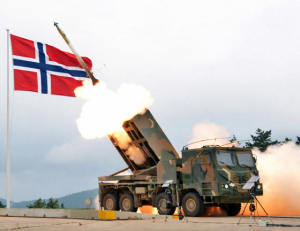
Around 700 Chunmoo launchers have been produced for domestic and export customersAccording to Norwegian media, Norway’s defense procurement agency Forsvarsmateriell (FMA) is expected to hold an official press briefing as early as Friday local time on the Long-Range Precision Fires (LRPF) acquisition. The briefing is likely to follow a parliamentary vote on the government’s proposal, fueling expectations that Oslo will soon clarify the program’s direction and shortlist.
Once viewed primarily as area-fire artillery, multiple rocket launchers have evolved during the Ukraine war into precision strike platforms capable of hitting command posts, logistics hubs and air-defense assets hundreds of kilometers away. That shift underpins Norway’s LRPF concept, which combines a land-based launcher with long-range guided munitions to deliver strike ranges of up to around 500 km.
Norway previously operated 12 U.S.-made M270 MLRS vehicles, all retired in 2005 and later drawn down for support to Ukraine. Oslo transferred three stored M270s to the United Kingdom in 2022 to backfill London’s donations, then provided eight more to Ukraine in May 2023—11 systems in total. With concerns mounting that Russia could resume military adventurism even after a ceasefire, Norwegian planners moved to reconstitute long-range land fires, accelerating the current competition.
The field has reportedly narrowed to Germany’s MARS 3, proposed by KNDS, and South Korea’s K239 Chunmoo from Hanwha Aerospace. The U.S. HIMARS was assessed early but has dropped out of the final contest, amid shifting transatlantic industrial and political dynamics, Norwegian outlets say.
MARS 3 is pitched as a next-generation system bridging artillery and tactical missiles, with guided rockets and missiles offering ranges of up to about 300 km. However, it is currently operated only by Germany and remains in the early phases of fielding, raising questions in Oslo about missile production capacity and delivery timelines. Political sensitivities linked to the system’s Israeli PULS heritage have also been cited as a complicating factor in Europe.
Chunmoo, by contrast, is seen as a mature, mass-produced platform already in operational service. Mounted on a wheeled, armored launcher with automated firing and reload, it can carry mixed pods—ranging from 131 mm and 230 mm rockets to 239 mm guided munitions—simultaneously. The 239 mm guided rockets are assessed to deliver GPS/INS accuracy comparable to U.S. GMLRS, while the system can also employ longer-range guided missiles under 300 km, meeting Norway’s precision-strike requirements.
Around 700 Chunmoo launchers have been produced for domestic and export customers, with roughly half already fielded by the Republic of Korea and overseas operators including Poland, Saudi Arabia and the UAE. Norwegian media say that proven production capacity, rapid delivery and combat-ready status are weighing heavily in evaluations. “Performance is comparable, but delivery schedules, political risk and operational maturity matter more than ever,” one outlet reported, noting that post-Ukraine procurement favors “weapons you can use immediately.”
Beyond a single acquisition, Norway’s LRPF program is viewed as a cornerstone of its post-Ukraine deterrence posture, reshaping the Army’s ability to hold high-value targets at risk across the High North. For South Korea, a Chunmoo selection would mark a symbolic breakthrough into the Nordic defense market, strengthening Seoul’s position as a global supplier of ready-to-field land-strike systems.
K-DEFENSE NEWS | Strategic Analysis Desk
#NorwayDefense #LongRangeFires #RocketArtillery #PrecisionStrike #MilitaryModernization #Chunmoo #K239 #HanwhaAerospace #KDefense #SouthKoreaDefense


 Hyundai Rotem Breaks $700 Million Operating Profit Barrier on Defense, Rail Boom
 ‘하늘의 눈’이 바뀐다…폴란드, 美 레이시온 첨단 정찰체계 선택
 폴란드, 브라질서 군용기 실전 점검… KC-390·A-29 도입 하나
 유로파이터 루마니아 전진배치… NATO 동남부 방공 태세 강화
 [대영제국] 디트로이트 전시장에 전격 등장! 차세대 전차 M1E3 실물 공개!
 목록
목록