The French Navy’s Suffren-class nuclear submarines are known to use uranium fuel enriched to below 20%, with refueling cycles of approximately 10 years.As interest grows around a Korean nuclear submarine, so too does attention toward Small Modular Reactors (SMRs) — one of the country’s key future energy and strategic technology initiatives. Some analysts now argue that SMRs could become a feasible propulsion option for the envisioned Korean nuclear submarine.
Most commercial reactors today use light-water reactor (LWR) technology, divided into pressurized water reactors (PWRs) and boiling water reactors (BWRs). Of these, PWRs make up roughly 70% of all operational LWRs. The concept was originally developed for military applications, first installed aboard the world’s first nuclear-powered submarine, the USS Nautilus. After proving the technology’s viability at sea, Westinghouse adapted the design for civilian use, including at the Three Mile Island nuclear power plant.
SMRs—despite their small size—are also predominantly pressurized water reactors. They represent a departure from gigawatt-scale power plants, generally producing 300 MWe or less. For comparison, Korea’s APR1400 reactor, exported to the UAE, delivers 1,400 MWe.
A key advantage of SMRs is scale: Up to 100 times smaller in volume than traditional large reactors, Major components—steam generator, coolant pumps, pressurizer—are integrated into a single pressure vessel, eliminating most external piping. This architecture significantly reduces the likelihood of catastrophic pipe-break incidents, one of the most serious risks associated with nuclear reactors.
Korea’s Two SMR Paths: i-SMR for Land, BANDI for the Sea
South Korea is currently developing two SMR platforms:
By comparison, the reactors installed on U.S., British, and French nuclear submarines typically deliver 50–60 MWe, placing BANDI squarely within the ideal performance envelope.
A typical nuclear submarine has an internal height of around 10–12 meters. Korea’s newest conventional submarine, ROKS Jang Young-sil, launched in October, measures 14.7 meters in height. With design optimization, the BANDI SMR’s dimensions could feasibly fit within a submarine hull, experts argue.
BANDI reportedly uses uranium fuel enriched below 5%, with a refueling cycle of 4–5 years. Increasing enrichment levels could extend operational life; for example, France’s Suffren-class submarines use sub-20% enriched uranium and refuel roughly every 10 years.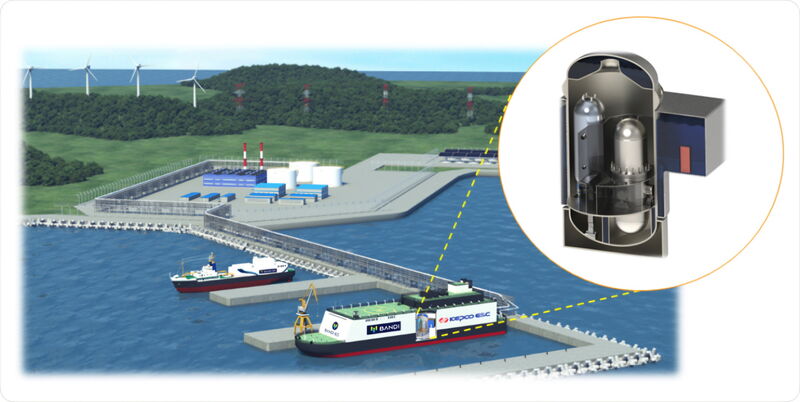 BANDI, developed as a marine SMR, is assessed to fall within the appropriate power range for nuclear submarines and to be suitably sized for submarine integration.
In November, Gyeongju Mayor Joo Nak-young wrote on social media that the Munmu the Great Science Research Center, now under construction in Gampo, “could serve as a foundation for future nuclear submarine propulsion technology.” The center is being built by the Korea Atomic Energy Research Institute (KAERI) to host the ARA multipurpose research reactor and conduct land-based testing of advanced marine reactors.
The facility is not designed to develop military propulsion reactors directly. However, KAERI’s advanced marine reactor (AMR) program—a civilian project—shares technological overlap with naval propulsion SMRs. As Mayor Joo noted, such research “could serve as foundational technology” for a future nuclear submarine reactor. Historically, all nuclear submarine programs have relied on land-based prototype testing. The USS Nautilus’s S2W reactor, for example, underwent more than a year of full-power testing on land before going to sea—an essential step to proving safety, stability, and operability.
For Korea, this implies several critical prerequisites: Securing an appropriate land-based test site, Completing environmental impact assessments, Achieving local community consent, Ensuring that shipyards and naval bases have radiation-shielded infrastructure comparable to nuclear power plants. Without these steps, even a fully developed reactor cannot be installed on a submarine.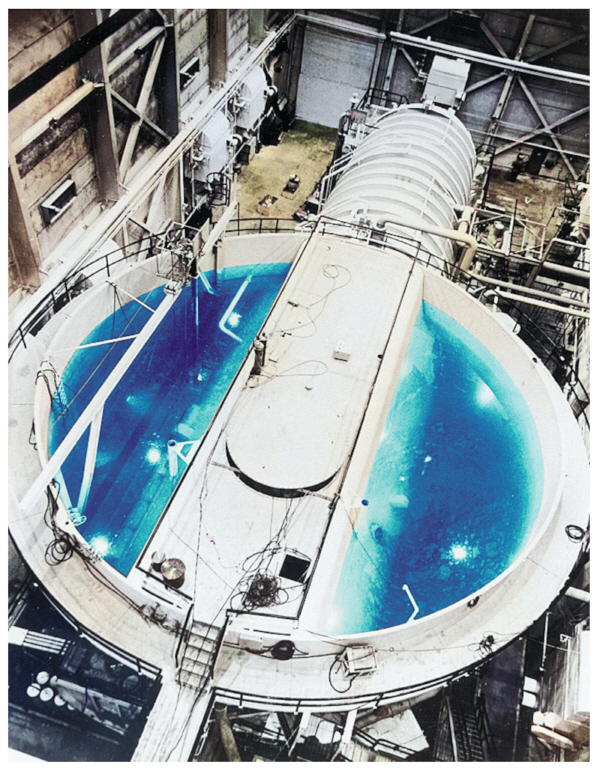 Even the world’s first nuclear-powered submarine, the USS Nautilus, tested its S2W reactor on land prior to construction, validating its safety through more than a year of trials before installing it on the submarine. The Road Ahead: Technology Ready, but Governance Needed
South Korea is now approaching a pivotal point. Reactor technology—particularly BANDI—appears increasingly compatible with submarine propulsion needs. But technology alone will not deliver a nuclear submarine.
A successful program will require: A whole-of-government task force, Clear division of responsibilities between MND, DAPA, MOTIE, and KAERI, Long-term political and public support, Community engagement at testing and construction sites.
Korea’s pursuit of a nuclear-powered submarine has moved closer to reality in recent months, but the decisive step will be land-based SMR validation—the same path every nuclear submarine-operating nation has taken. Whether BANDI or another SMR becomes the “heart” of Korea’s first nuclear submarine will ultimately depend not only on engineering, but on national consensus and sustained strategic commitment.
K-DEFENSE NEWS | Strategic Analysis Desk


 South Korea Retires HH-32 Helicopters, Ending a Rare Era of Military Ties with Russia
 엘빗, 독일에 ‘유로펄스’ 유도탄 생산 허브 구축
 [단독] T-50i 2차분, 인도네시아 공군 인도 본격화
 미 해군, 하푼 블록 II 성능 개량형 최종 비행 시험 완료
 노르웨이에 천무 16문, 2.8조원 규모 수출! 사거리 500km 미사일 장착한다
 목록
목록