A Republic of Korea Air Force HH-32 helicopter—the service’s only Russian-built aircraft as of last year—conducts a mission. Introduced in 2003, the HH-32 has been used for search-and-rescue operations as well as specialized aerial firefighting missions. The HH-32 fleet, which completed its final operational duty at the end of last year, had long served as the backbone of the ROKAF’s search-and-rescue (SAR) mission set.
These missions include the recovery of downed fighter pilots as well as the rescue of civilians trapped or stranded during natural disasters. As of its retirement, the HH-32 was the only Russian-made aircraft still operated by the South Korean Air Force.
Introduced into service in 2003, the HH-32 was also widely recognized for its effectiveness in aerial firefighting, particularly during large-scale wildfires—an increasingly critical mission in South Korea over the past two decades.
The HH-32 is derived from the Ka-32 helicopter designed by Russia’s Kamov Design Bureau. In South Korea, the aircraft is commonly known as the “Kamov” helicopter, a name more familiar to the public than its NATO reporting name, “Helix,” due to its frequent appearances over wildfire zones and disaster areas.
The Ka-32 gained a reputation for its coaxial contra-rotating rotor system, high engine output, and strong performance in adverse weather conditions, offering considerable capability at a relatively competitive cost. Early in its service life, however, South Korean operators faced challenges typical of Russian-origin equipment, including maintenance complexity and difficulties in securing spare parts.
These perceptions shifted over time. By the mid-2000s, repeated success in disaster response and wildfire suppression led to broader acceptance of the platform. The Korea Forest Service and the Korea Coast Guard expanded their own Ka-32 operations, while additional aircraft were introduced across both government and civilian sectors. As a result, South Korea today operates the second-largest Ka-32 fleet in the world.
The ROKAF acquired its Ka-32s under the second phase of the so-called “Brown Bear Project,” designating the aircraft HH-32 after limited modifications carried out with support from Israeli defense firms.
The origins of the HH-32 lie in the Brown Bear Project, an unusual arms procurement program born out of Russia’s inability to repay South Korea’s Economic Development Cooperation Fund (EDCF) loans following the collapse of the Soviet Union.
Under the formal agreement—officially titled the Agreement on Military Technology, Defense Industry, and Logistics Cooperation between the Government of the Republic of Korea and the Government of the Russian Federation—Russia repaid part of its debt through the transfer of military equipment rather than cash. Initiated in 1990, the program represented a highly uncommon form of state-level military cooperation between former Cold War adversaries.
The first phase of the Brown Bear Project ran from 1995 to 1998, covering approximately USD 214 million in loan repayments. South Korea received 33 T-80U main battle tanks, 33 BMP-3 infantry fighting vehicles, 70 Metis-M anti-tank missile launchers with 1,250 missiles, as well as Igla man-portable air defense systems.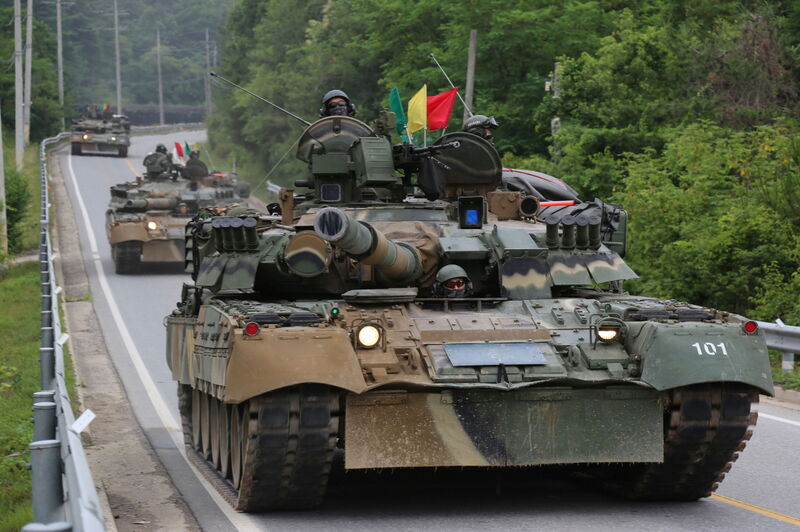 ROK Army-operated T-80U main battle tanks and BMP-3 infantry fighting vehicles provided the ROK military with firsthand insight into Russian armored tactics, operational doctrine, and equipment design—experience later used to inform the development of next-generation armored forces.
Following Russia’s 1998 debt moratorium, a second phase was negotiated and implemented between 2002 and 2006. Valued at USD 534 million, half of the arrangement involved additional loan repayment, while the remainder was funded through direct cash payments by the South Korean government.
This phase included two additional T-80U tanks, more BMP-3 vehicles—some equipped with thermal imaging systems—Metis-M missiles, three Murena-class air-cushion landing craft, Il-103 trainer aircraft, and the Ka-32 helicopters later designated HH-32.
Beyond strengthening force structure, the acquisition gave the South Korean military an unprecedented opportunity to study modern Russian ground and missile systems firsthand. Analysis of Russian armored doctrine, operational concepts, and equipment design informed future force planning and contributed indirectly to the evolution of indigenous platforms.
Several technologies introduced through the Brown Bear Project influenced South Korea’s domestic defense programs. The T-80U’s nuclear, biological, and chemical (NBC) protection system—particularly its internal radiation shielding—was notably absent from Western tanks of the era. Elements of this concept were later adapted for the K2 Black Panther main battle tank.
Similarly, South Korea’s Shin-Gung (Chiron) short-range surface-to-air missile incorporated aerodynamic features inspired by the Igla system, including a spike-type drag reduction device that significantly improved seeker tracking performance. The missile’s infrared seeker itself was also extensively upgraded based on lessons learned from Russian designs.
Nevertheless, drawbacks remained. Russian-origin equipment proved costly to maintain, and spare parts became increasingly difficult to procure—issues that fueled growing calls for retirement throughout the 2010s.
The situation worsened in the 2020s as international sanctions on Russia intensified, severely constraining supply chains. Russia’s invasion of Ukraine in 2022 further exacerbated these challenges.
Although T-80U and BMP-3 platforms maintained high readiness rates—peaking at 96% and 98%, respectively, according to National Assembly audit data—they were withdrawn from frontline units in late 2021 and replaced by domestically produced K1E1 tanks and K200-series armored vehicles. Remaining assets were reassigned to opposition-force units for training purposes.
Ka-32 helicopters operated by other government agencies have also begun to be phased out in favor of domestically produced or alternative foreign platforms. While the possibility of transferring Russian-origin equipment to Ukraine was briefly discussed, legal restrictions under bilateral defense agreements and broader security implications prevented any such move.
Born in the geopolitical vacuum of the post–Cold War era, the Brown Bear Project left a lasting imprint on South Korea’s military modernization. Yet as global politics realign and strategic realities shift, the retirement of the HH-32 marks the quiet conclusion of an extraordinary, and unlikely, chapter in defense cooperation history.
K-DEFENSE NEWS | Strategic Analysis Desk
#BrownBearProject #ArmsTransfer #SanctionsImpact #UkraineWar #T80U #Tank #BMP3 #HH32 #Ka32


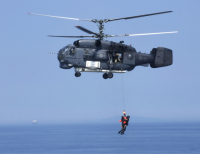 South Korea Retires HH-32 Helicopters, Ending a Rare Era of Military Ties with Russia
 엘빗, 독일에 ‘유로펄스’ 유도탄 생산 허브 구축
 [단독] T-50i 2차분, 인도네시아 공군 인도 본격화
 미 해군, 하푼 블록 II 성능 개량형 최종 비행 시험 완료
 노르웨이에 천무 16문, 2.8조원 규모 수출! 사거리 500km 미사일 장착한다
 목록
목록