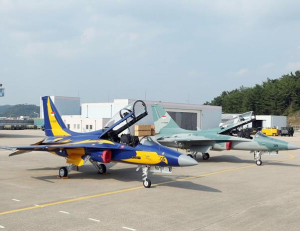
The ESR-500A, Korea’s first air-cooled AESA radar developed by LIG Nex1 for the FA-50, electronically controls approximately 500 transmit/receive (T/R) modules, enabling faster beam steering, expanded detection coverage, and multi-mission capability through simultaneous operation modes. As a result, the system can also engage multiple targets concurrently. The company announced on the 5th that it signed two research agreements with the Defense Technology Promotion Research Institute (DTPRI) on November 28. The projects include: Development of an X-band Common MMIC and Front-End Module Platform for AESA Radar, and Development of a Wideband Common MMIC and Front-End Module Platform for UAV SAR.
The AESA radar semiconductors to be developed under this program are core components applicable to multi-function radars, fighter-class AESA radars, low-observable unmanned teaming aircraft, Korea’s future stealth UAV systems, and other wideband radar platforms. The objective is to create ultra-compact, high-performance semiconductor devices capable of integration into advanced weapon systems.
Defense-grade semiconductors play an essential role across critical systems—from radars and guided weapons to military communications. However, South Korea’s defense sector remains highly dependent on foreign suppliers, creating vulnerability amid global supply chain instability. Recognizing these risks, the government has prioritized the localization of defense semiconductors as a national imperative. Achieving independent production capacity is viewed as essential for ensuring uninterrupted operation of key military assets.
LIG Nex1 already possesses an export-configured air-cooled AESA radar. If the company succeeds in domesticating the semiconductor components that form the “core engine” of AESA radar technology, it is expected to secure a reliable supply chain for future high-performance AESA radar programs—particularly those for upcoming manned-unmanned combat aircraft that will be led by the Agency for Defense Development (ADD). The advancement is also expected to significantly enhance Korea’s technological autonomy in radar and defense electronics, providing a critical foundation for adapting to rapidly evolving future battlefields.


 South Korea Retires HH-32 Helicopters, Ending a Rare Era of Military Ties with Russia
 엘빗, 독일에 ‘유로펄스’ 유도탄 생산 허브 구축
 [단독] T-50i 2차분, 인도네시아 공군 인도 본격화
 미 해군, 하푼 블록 II 성능 개량형 최종 비행 시험 완료
 노르웨이에 천무 16문, 2.8조원 규모 수출! 사거리 500km 미사일 장착한다
 목록
목록