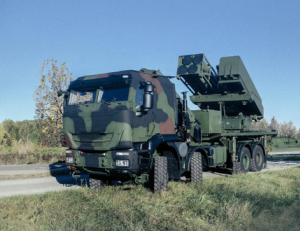
Chunmoo is capable of delivering sustained fire to strike the source of enemy provocations, including long-range artillery. The system can maneuver to a firing position at speeds of up to 80 km/h, and once it arrives, it can launch its first round within a matter of minutes, providing rapid-response capability.Hanwha Aerospace Unveils Chunmoo 3.0 at Seoul ADEX 2025
The system integrator and prime contractor, Hanwha Aerospace, presented its latest variant, Chunmoo 3.0, at the Seoul ADEX 2025 exhibition in October. The new version features major upgrades to both the launcher vehicle and the missile family. A key improvement is survivability. Unlike the current ROK Army variant, the launcher of Chunmoo 3.0 incorporates additional armor capable of stopping AP (armor-piercing) small-arms rounds, addressing a known vulnerability of previous versions. The launcher also integrates a remote-controlled weapon station, smoke grenade launchers, and enhanced defensive features to improve protection during movement and firing. Chunmoo 3.0 also introduces new guided and loitering munition options, significantly expanding the system’s strike envelope.
Among the newly revealed weapons is the L-PGW (Loitering Precision Guided Weapon), a hybrid system combining an 80 km-class rocket body with a detachable AI-enabled kamikaze drone. After launch, the drone separates in flight, conducts autonomous reconnaissance and detection, relays sensor data via satellite datalink, and dives onto the target once the operator authorizes a strike. The integration of loitering munitions directly into an MLRS launcher is considered one of Chunmoo 3.0’s most innovative features. Also showcased was a new anti-ship missile variant designated CTM-ASBM, believed to offer up to 160 km range. The missile uses an uncooled IR seeker derived from the “Bi-ryong” 130 mm guided rocket deployed on the ROK Navy’s PKMR-class patrol craft, enabling precision strikes against surface combatants. L-PGW (Loitering Precision Guided Weapon)
The system will also be able to fire the KTSSM-II, an upgraded tactical surface-to-surface missile with improved penetration and extended strike range. The Defense Acquisition Program Administration (DAPA) launched the KTSSM-II development project in September 2023, allocating roughly KRW 200 billion (USD 150 million) for system development through December 2027. Although exact specifications remain classified, Korean defense officials note that KTSSM-II, when fired near the Military Demarcation Line (MDL), is expected to reach as far as the Yalu River, offering performance comparable to or surpassing the U.S. ATACMS. Before KTSSM-II reaches service, an interim variant—CTM-290—has already entered export markets, including Poland and reportedly several Middle Eastern states. CTM-290 features a 600 mm diameter, 4 m length, 1.5-ton weight, INS/GPS guidance, and a CEP of roughly 9 meters. A single CTM-290 can be loaded per pod, with Chunmoo capable of carrying two pods per launcher.
For now, the global MLRS market is led by the U.S. HIMARS, which passed its 750th delivered unit on November 15, according to Lockheed Martin. HIMARS has earned a formidable reputation for long-range precision strikes, especially following its operational success in Ukraine, where it crippled Russian ammunition depots, command centers, and artillery batteries—reshaping modern artillery warfare toward precision rather than volume fires. HIMARS production is now doubling, with the Camden, Arkansas plant ramping from 48 to 96 units annually. Yet Chunmoo is catching up quickly. Between ROKA/ROKMC units and ongoing foreign contracts, more than 700 Chunmoo launchers are already produced, deployed, or in the production pipeline—placing it just behind HIMARS in global distribution.
While HIMARS remains the benchmark for precision and mobility, Chunmoo offers compelling advantages:
Double the on-board firepower (12 guided rockets per launcher vs HIMARS’ 6)
Multiple pod types enabling rockets, tactical missiles, loitering munitions, and anti-ship missiles
Lower acquisition and sustainment cost
Cluster munition compatibility (where permitted)
Flexible local production packages for customers such as Poland
Rapid delivery timelines Between ROKA/ROKMC units and ongoing foreign contracts, more than 700 Chunmoo launchers are already produced, deployed, or in the production pipeline—placing it just behind HIMARS in global distribution.
These factors have led some overseas observers to dub Chunmoo a “Super HIMARS.”
Industry officials say that with current contracts and ongoing negotiations—including Romania, Finland, Norway, Iraq, and several Middle Eastern nations—Chunmoo’s export potential alone could reach 600–700 launchers, not including additional ROKA acquisitions.
“Chunmoo has effectively become one of the core systems shaping the global MLRS market,” a defense industry insider told K-Defense News. “Demand continues to grow as nations seek scalable and cost-effective deep-strike capabilities.”
If current trends continue, the combined inventories of South Korea and its foreign partners could surpass 1,000 Chunmoo launchers worldwide in the 2030s—marking a historic milestone for Korean land-based precision firepower.
K-DEFENSE NEWS | Strategic Analysis Desk


 South Korea Retires HH-32 Helicopters, Ending a Rare Era of Military Ties with Russia
 엘빗, 독일에 ‘유로펄스’ 유도탄 생산 허브 구축
 [단독] T-50i 2차분, 인도네시아 공군 인도 본격화
 미 해군, 하푼 블록 II 성능 개량형 최종 비행 시험 완료
 노르웨이에 천무 16문, 2.8조원 규모 수출! 사거리 500km 미사일 장착한다
 목록
목록