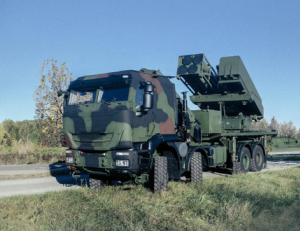
The origins of multiple rocket artillery on the Korean Peninsula are often traced back to the Hwacha(화차), a rocket-launching weapon developed during the Joseon Dynasty.The agreement covers 16 Chunmoo launchers, guided munitions, and comprehensive logistics support. With this deal, the K-MLRS Chunmoo has firmly established itself as a global multiple launch rocket system operated by five countries, including South Korea.
At present, around 350 Chunmoo launchers are already fielded by user nations, with another 340 units under production. Including the Norwegian order, the total number of Chunmoo systems deployed worldwide is expected to reach roughly 720 units in the coming years.
As of December last year, the undisputed heavyweight of the global MLRS market remains the U.S.-made HIMARS, with approximately 750 units produced and operated by the U.S. Army, Marine Corps, and armed forces of more than ten countries. Close behind, however, is Korea’s Chunmoo, which has effectively secured second place globally in terms of scale.
Behind this competitiveness lies what many describe as Korea’s unique “DNA of firepower.” The origins of multiple rocket artillery on the Korean Peninsula are often traced back to the Hwacha(화차), a rocket-launching weapon developed during the Joseon Dynasty. Around 1451, Singijeon rocket-equipped Hwacha systems—developed under Prince Munjong—were produced in numbers exceeding 90 and played a decisive role in securing the northern frontiers during the reign of King Sejong.
More than 500 years later, the first indigenous weapon system developed by the Republic of Korea after its founding was, once again, a multiple rocket launch system. The Koo Ryong (“Nine Dragons”) MRLS gained international recognition when it was introduced in the 1981–1982 Armoured Fighting Vehicles and Artillery yearbook published by Jane’s—the first ROK-made weapon ever featured in the globally authoritative defense reference. While Koo Ryong attracted international attention, it did not translate into large-scale exports.
The concept of MLRS has since evolved dramatically. Traditionally viewed as area-suppression artillery capable of delivering massive rocket salvos in a short time, MLRS systems have been transformed by the war in Ukraine into precision strike platforms integrated with long-range guided missiles. Today, they are increasingly regarded as strategic assets capable of striking enemy command posts, logistics hubs, and air defense systems with precision from hundreds of kilometers away.
Chunmoo, the successor to Koo Ryong, was developed in line with this paradigm shift. Fielded by the Korean military in August 2015, Chunmoo can fire both unguided rockets and the CGR-080 guided rocket with a range of up to 80 km. An export variant supplied to Poland, known as Homar-K, is capable of launching the CTM-290 tactical surface-to-surface missile with a range of 290 km.
For the Norwegian competition, Hanwha Aerospace proposed a tactical missile with a reported range of up to 500 km—widely seen as the decisive factor that set Chunmoo apart from rival systems.
The evolution of Korea’s K-MLRS is ongoing. At Seoul ADEX 2025, Hanwha Aerospace unveiled Chunmoo 3.0, featuring significantly expanded roles for both the launcher vehicle and its munitions. The launcher now incorporates armored protection against small-arms fire, while its payload options have been broadened. Among the most notable additions is the integration of the loitering precision guided weapon (L-PGW) in combination with unmanned systems. A new surface-to-surface anti-ship missile was also revealed.
Known as CTM-ASBM, the missile reportedly has a maximum range of 160 km and employs an uncooled infrared seeker derived from the Biryong anti-ship missile used by fast attack craft of the Republic of Korea Navy, enabling precise engagement of maritime targets.
Today, Chunmoo has emerged as one of the most influential systems in the global MLRS market. Potential future customers are said to include Romania, Spain, and Iraq. Should additional orders materialize, analysts suggest that the world could enter the era of “1,000 Chunmoo launchers” sometime after 2030—marking a new chapter in the global spread of Korea’s firepower heritage.
K-DEFENSE NEWS | Strategic Analysis Desk
#Chunmoo #KMLRS #KDefense #RocketArtillery #PrecisionStrike


 South Korea Retires HH-32 Helicopters, Ending a Rare Era of Military Ties with Russia
 엘빗, 독일에 ‘유로펄스’ 유도탄 생산 허브 구축
 [단독] T-50i 2차분, 인도네시아 공군 인도 본격화
 미 해군, 하푼 블록 II 성능 개량형 최종 비행 시험 완료
 노르웨이에 천무 16문, 2.8조원 규모 수출! 사거리 500km 미사일 장착한다
 목록
목록