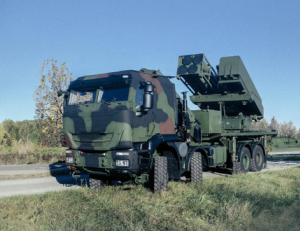
IBCS is emerging as a critical element for transforming KAMD into a sustainable, integrated air defense system capable of enduring modern high-intensity conflict.Not “layered,” but integrated: lessons from Israel and Ukraine
The wars in Israel and Ukraine make this reality unmistakably clear. Both conflicts demonstrate that an air defense concept centered on interception rates alone has reached its limits. Without integrated air defense command and control (C2), defensive sustainability collapses.
Israel has institutionalized a three-tier structure over decades. Offensive actions reduce launch capacity before attacks occur; active air and missile defense intercepts residual threats; and passive defense—early warning, shelters, and hardened infrastructure—absorbs leakage. Crucially, these layers do not operate independently. They function as a single adaptive system, with pressure shifting dynamically between layers as conditions change.
Ukraine, by contrast, built integration under fire. Early in the war, Soviet-era air defenses denied Russian air superiority, but prolonged fighting exposed interceptor shortages and the limits of static designs. Kyiv subsequently transitioned to a hybrid architecture combining Western systems—Patriot, NASAMS, and IRIS-T—with legacy assets, while adding mobile MANPADS teams and low-cost countermeasures to spread defensive burden. Different paths led to the same conclusion: air defenses that are not integrated are exhausted first.
This is where the U.S. Army–standard IBCS, produced by Northrop Grumman, enters the discussion. IBCS breaks away from the traditional model that pairs specific sensors with specific shooters. Instead, it integrates disparate sensors, fire-control systems, and interceptors into a single networked architecture.
Its core concept—“Any Sensor, Best Shooter”—allows the system to automatically select and assign the most suitable interceptor based on real-time threat data and engagement geometry. The military effects are straightforward. In saturation conditions, IBCS reduces wasteful expenditure of high-end interceptors, preserves combat endurance, and provides resilience by reconfiguring data paths even when sensors or launchers are degraded or destroyed. As a result, IBCS is increasingly viewed not merely as a connector, but as an operational logic for managing air-defense overload.
The relevance of IBCS grows further in coalition operations. As U.S. forces field IBCS-based air and missile defense at scale, allied command architectures that remain fragmented risk losing real-time data sharing and automated coordination. In Europe, Poland has already set a benchmark by declaring Full Operational Capability for its IBCS-integrated Patriot-based Wisła medium-range air defense system, demonstrating that integrated C2 can serve as a common standard for allied defense.
For the KAMD, the challenge is structural rather than quantitative. The priority is not simply acquiring additional interceptors, but overcoming fragmentation between sensors, fire-control elements, and engagement decision authorities, and transitioning to a network-based integrated C2 architecture. At stake is the ability to preserve and rotate defensive assets in a prolonged air campaign.
The message from Israel and Ukraine is unambiguous. Interception alone is not enough. As missiles and drones become cheaper and more numerous, command-and-control systems must become more sophisticated. In saturation air and missile warfare, victory is determined not by individual weapon performance, but by the speed of integration—the ability to see the battlespace, decide rapidly, and allocate the optimal defensive response.
From this perspective, IBCS is no longer a discretionary option. It is emerging as a critical element for transforming KAMD into a sustainable, integrated air defense system capable of enduring modern high-intensity conflict.
K-DEFENSE NEWS | Strategic Analysis Desk
#IBCS #KAMD #NorthropGrumman #AirDefense #C2


 South Korea Retires HH-32 Helicopters, Ending a Rare Era of Military Ties with Russia
 엘빗, 독일에 ‘유로펄스’ 유도탄 생산 허브 구축
 [단독] T-50i 2차분, 인도네시아 공군 인도 본격화
 미 해군, 하푼 블록 II 성능 개량형 최종 비행 시험 완료
 노르웨이에 천무 16문, 2.8조원 규모 수출! 사거리 500km 미사일 장착한다
 목록
목록